Book a call

Tell us what you are trying to fix. You get a reply within 24 hours with two or three times to choose from, no automated sequence.

Why speed decides it

When there are more openings than people, the applicant is the one choosing

Two figures describe the Connecticut labour market a shop is hiring into. Neither depends on any particular technology, and together they explain why the first callback wins.

455

machinist roles were open across Connecticut in a single month, against a skilled workforce that is shrinking as it retires.

Connecticut job board listings, August 2026

1.9 million

of the 3.8 million manufacturing roles opening nationally through 2033 are projected to go unfilled.

Deloitte and The Manufacturing Institute, widely reported

Read together, those two figures invert the thing most shops still assume. A good fitter is not competing for your job. Your job is competing for him, against every other shop within a forty minute drive and against a submarine yard hiring thousands out of the same pool. He is not weighing offers he has not received yet. He takes the first one that turns into a phone call.

So the deciding interval is short, it starts the moment he presses send, and almost nothing about it is visible from inside the business. The applications you never received leave no trace, and the man who gave up halfway through your form does not send you a note about it. That is an operational problem rather than a technological one. It needs a system that replies at any hour, applies the same process every time, and records when it did.

What we commit to

Every applicant gets a reply in under two minutes, day or night. You get the board showing every response time recorded, not a summary at the end of the month. If a reply fails to send, that is recorded too, and it shows on your board rather than being quietly rounded away.

We are not going to promise you a hire. Nobody can, and a firm that does is telling you something about how it handles the rest of the truth. What is promised here is the work and the evidence: the listing written, the floor filmed, the advertising run, every applicant answered, and every one of those times on a clock we do not control.

The system

Two screens, one job

There is no software for you to learn and nothing for your foreman to maintain. One page for the man applying, one board for you. Everything between them runs on its own.

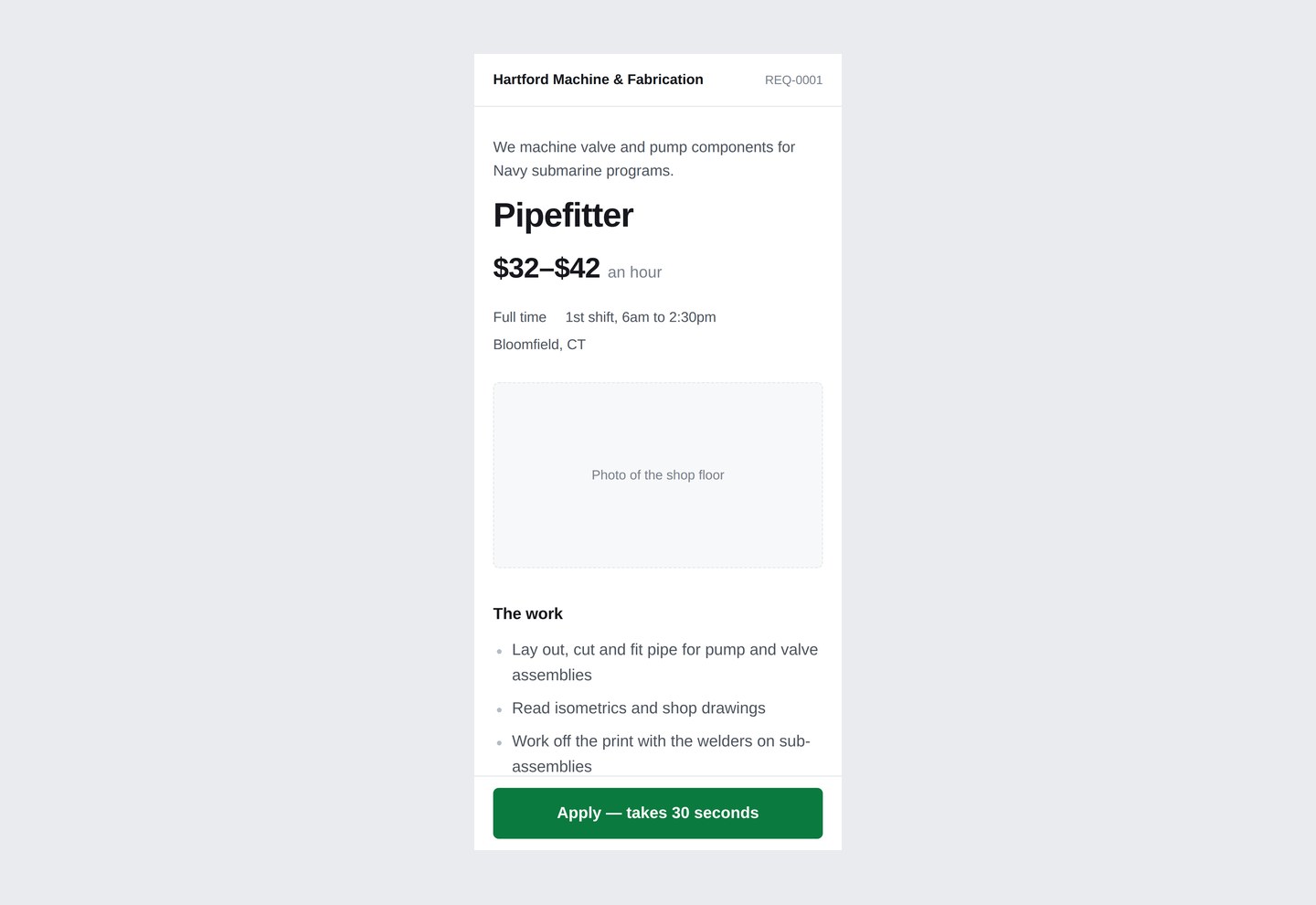
The HireMe job page on a phone, showing the pay range, the work, and a short application form

What he sees

The job page

Seven questions, finished in a parking lot at 6:40am

// The problem

He taps Careers on his phone before shift. It opens his mail app, blank, addressed to info at your company. His resume is on a laptop at home. He tells himself he will do it tonight. He does not. Nobody records that he tried, so it never appears anywhere, and the seat stays empty for another month.

// What we built

A page that opens on one bar of signal and an application he can finish standing up. Name, number, trade, years, tickets, when he can start, and two questions you choose. No account, no password, no resume. Pay sits under the title where he looks for it first.

  • 7 questions
  • No account or resume
  • Readable before scripts load
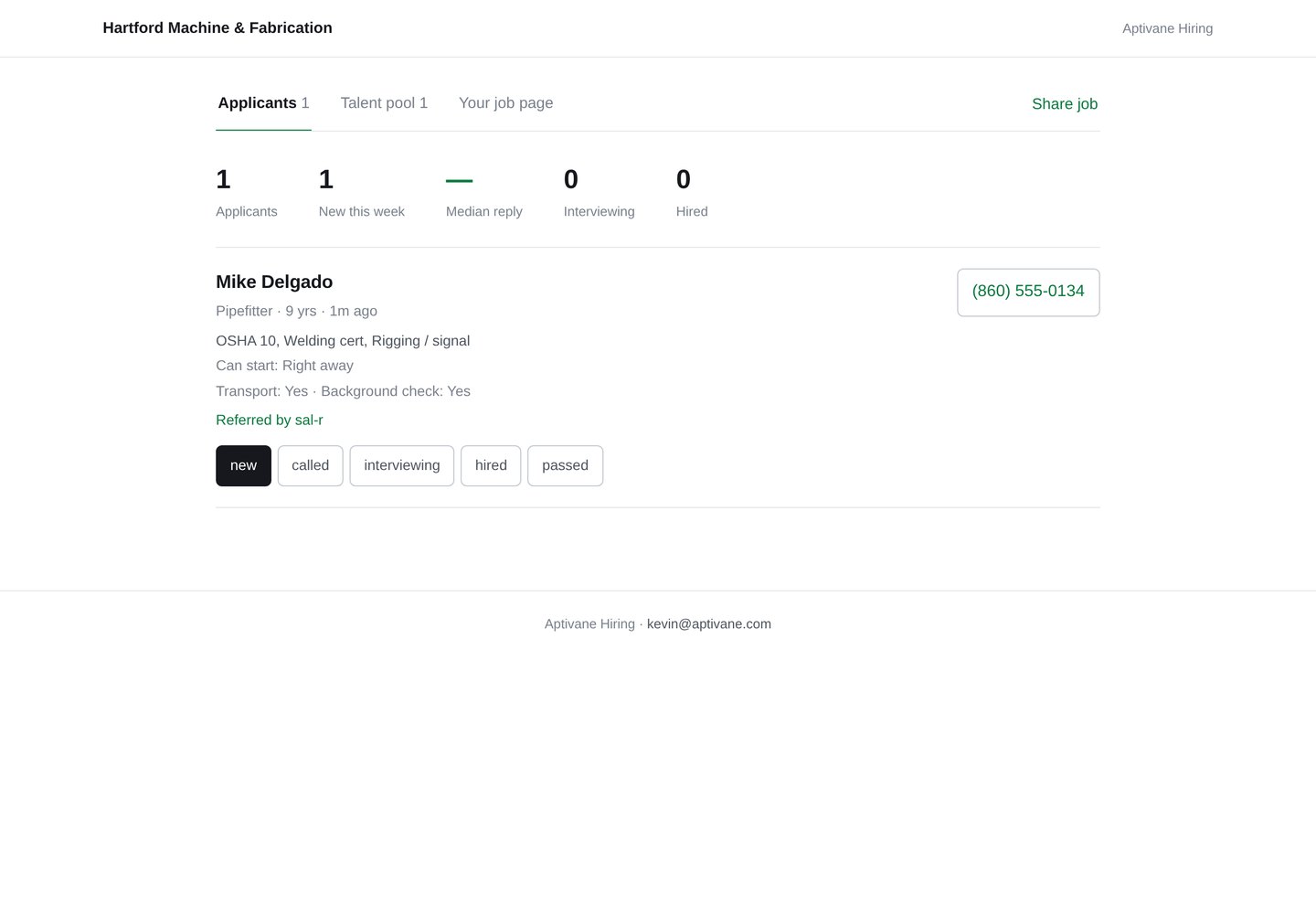
The HireMe board showing applicants, response times, tickets held, and the talent pool

What you see

The board

Everyone who applied, and how fast we answered them

// The problem

Applications arrive in an inbox that four people half own. Somebody means to call him back on Thursday. By Thursday he has started somewhere else, and there is no record of him anywhere, so the next time you need a fitter you start from nothing and pay to find him twice.

// What we built

One board. Newest first, tickets and years on the card, and the phone number is the biggest thing you can press. Nobody types into it: it fills itself as people apply. Everyone who ever applied stays in the talent pool, filterable by trade and ticket, so the next opening starts with a list instead of a blank page.

  • Nothing to type in
  • Talent pool compounds
  • Response time recorded

What clients ask before signing

What does it cost?

One thousand two hundred and fifty a month for a single open role, two thousand five hundred for up to three, four thousand five hundred for unlimited roles across more than one location. Advertising is extra and billed at cost on your own card, usually four hundred to twelve hundred a month. There is also a performance option: a thousand a month plus three thousand five hundred for each hire still there at ninety days. Set up is normally fifteen hundred and is waived for our first three Connecticut shops.

How is this different from a staffing agency?

An agency charges ten to twenty five thousand dollars for one welder or machinist, owns the relationship with that person, and when he leaves in six months you pay it again. Here the applicants are yours, everyone who ever applied stays in your talent pool, and the cost per hire falls every time you use it rather than resetting.

We already have a careers page. Does this still do anything?

Probably, and there is a fast way to find out. Open your own careers page on your phone and apply for one of your jobs. Time how long it takes and count how many times you needed something that was not in your pocket. Then see how long it takes anyone to get back to you. That test takes five minutes and it answers the question better than we can.

How quickly can the text replies go live?

The reply to an applicant goes out by text, and text needs a carrier registration in your business name. Every US carrier now requires one before any business can send automated messages. We file it using your EIN and registered legal name, and approval usually takes a few days and occasionally a few weeks. Until it clears we do not start your advertising, because the two minute reply is the thing you are buying and running a version of this without it would waste your money and your applicants. The listing, the job page and the board are all set up while we wait.

Do we have to publish the pay rate?

No, and we will tell you plainly what it costs you. A listing without a rate is the most common reason a good tradesman scrolls past, because he reads it as a shop that wants to negotiate from underneath. If you would rather not print a number we will write the listing without one, and we will show you the difference in applications when you change your mind.

How many people are you going to find us?

We are not going to give you a number, because anyone who does is guessing at your pay rate, your shift and your reputation. What we will tell you is how many people saw the job, how many started the application, how many finished it, and how fast every one of them was answered. If applications are coming in and nobody is taking the job, that is a pay conversation and we will say so rather than sell you another month.

Who actually does the work?

We do. You will not be sent a template to fill in or asked to supply your own photographs. We write the listing, come to the shop and film it, run the advertising, and answer the applicants. What you do is pick up the phone when it buzzes.

What happens if we stop?

Thirty days notice after the first three months, no exit fee. Every applicant record exports on request, including on the last day. The job pages come down and the phone number stops, but the people who applied to you stay yours.
Book a call

Twenty minutes, no pitch deck. Tell us what is slow, missed or done by hand at the moment. If we are not the right fix for it, we will say so on the call.

By sending this, you agree that Aptivane may contact you by text and email about your enquiry. Message frequency varies. Message and data rates may apply. Reply STOP to opt out or HELP for help. See our privacy policy. We never sell or share your number.

Rather just call or email?